Life after USAID: Young entrepreneurs in Ethiopia are a case study in resilience
A daycare centre, a tailoring shop, and a café: three stories speak to the determination of young people in Ethiopia after the sudden withdrawal of USAID funding.
Beta Ade: Building a business that’s entirely her own
“I realised there was a gap in my community. Many mothers wanted to go out to work and provide for their families, but they could not do so because they had small children at home.”
Beta Ade is 27 years old and speaks to us from the daycare centre she runs in Tulu Dimtu, on the southern outskirts of Addis Ababa: well-kept rooms, colourful walls, and comfortable mattresses for kids to rest. Hers is a story of resilience that began before the Trump administration dismantled USAID in early 2025.
The dramatic – and sudden – reduction in funding hit many countries, including Ethiopia, hard. But more than one year later, Beta’s business is still running, thanks to her own determination and to Kefeta Youth SACCO, the savings and credit cooperative supported by Amref Health Africa and led by young people in Addis Ababa.
“I thought it was a good opportunity, not only for them [the mothers in my neighbourhood] but also as an activity for me,” says Beta, who graduated in midwifery. “I always wanted to open a business that would be entirely my own”. The game-changing loan Beta obtained through Kefeta arrived within a week. Today, her business has grown, and she’s thinking beyond her own ambitions: “I have four employees, so I am also able to support them through this activity”.
But the uncertainty caused by the sudden withdrawal of USAID funding — which affected many development and health programmes in Ethiopia, including those designed to support and empower young people — can be felt here too. Beta’s venture was so successful that she applied for a second loan to expand the daycare and open new branches, but “they told me there is a waiting list”. The SACCO now has limited funds. And yet, amidst her concern, Beta notices something that speaks to sustainability: “Most SACCOs I know collapse when funding stops. This one is still able to sustain the entire system”. It is the same logic that Amref Health Africa chose to follow after the cuts: not to shut everything down, but to adapt to the new reality, continuing to generate impact over time.
Choosing to continue
Wasihun Andualem, head of Amref’s youth programmes in Ethiopia, tells a similar story. When USAID was dismantled, Amref’s youth programme portfolio was reduced by more than 90%. This meant activities that ground to a halt almost overnight, scaled-down services, youth centres reduced in number from 23 to 10, and the closure of 88 information points related to sexual and reproductive health and family planning. As a result, the number of young people supported fell by almost half, from two million to just over one.
In this scenario, resilience is not a buzzword: it is a determined, operational choice. For Amref and the young people it supports, one pillar is the strengthening of digital skills in ten youth centres, with investments in infrastructure and online platforms. More than 50,000 young people have been able to access digital training and careers advice as a result.
The second pillar is Kefeta which, despite everything, continues to function, is expanding its base, and today has nearly 14,000 active members. About 90% of loans support small businesses run by young people. On average, each activity generates work for at least two other young people, creating a multiplier effect that becomes all the more crucial when resources decline.
Wasihun Andualem, head of Amref’s youth programmes in Ethiopia, tells a similar story. When USAID was dismantled, Amref’s youth programme portfolio was reduced by more than 90%. This meant activities that ground to a halt almost overnight, scaled-down services, youth centres reduced in number from 23 to 10, and the closure of 88 information points related to sexual and reproductive health and family planning. As a result, the number of young people supported fell by almost half, from two million to just over one.
In this scenario, resilience is not a buzzword: it is a determined, operational choice. For Amref and the young people it supports, one pillar is the strengthening of digital skills in ten youth centres, with investments in infrastructure and online platforms. More than 50,000 young people have been able to access digital training and careers advice as a result.
The second pillar is Kefeta which, despite everything, continues to function, is expanding its base, and today has nearly 14,000 active members. About 90% of loans support small businesses run by young people. On average, each activity generates work for at least two other young people, creating a multiplier effect that becomes all the more crucial when resources decline.
Tsion Gebreheywot: A path that suits her perfectly
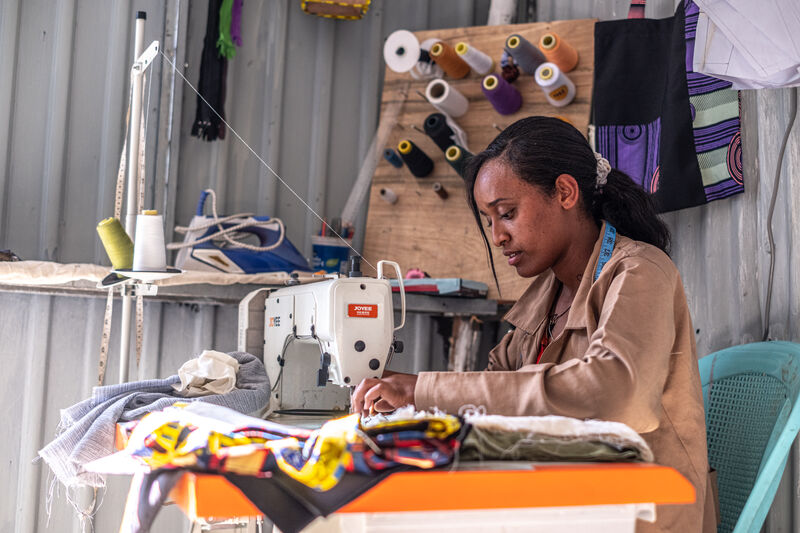
In Galan, on the outskirts of Addis Ababa, 23-year-old Tsion Gebreheywot runs a tailoring business. “I chose this path because it is something that suits me perfectly,” she says. She came into contact with Kefeta during a training session at college: “They told us about the loan programme for young people, where the interest rate was lower than in other organisations”. In addition to the loan, Tsion highlights the value of the training: “They trained us on life skills, on how to prepare a business plan”.
But today, growth has slowed: “The process [of obtaining an additional loan] is delayed and I have been waiting for a long time, because of the shortage in available funds”. For Tsion, the effect is concrete: “If I had received the money on time, I would have hired more people and bought more machines, while I am still working with only one machine. It is difficult”. And yet she, too, sees that the model is holding: “Even after the funding cut, Kefeta is still active”. She has even noticed small signs of progress: “The old office was very small, while the current one […] is excellent. It looks like a real bank”.
Tsion Sertse: From employee to entrepreneur
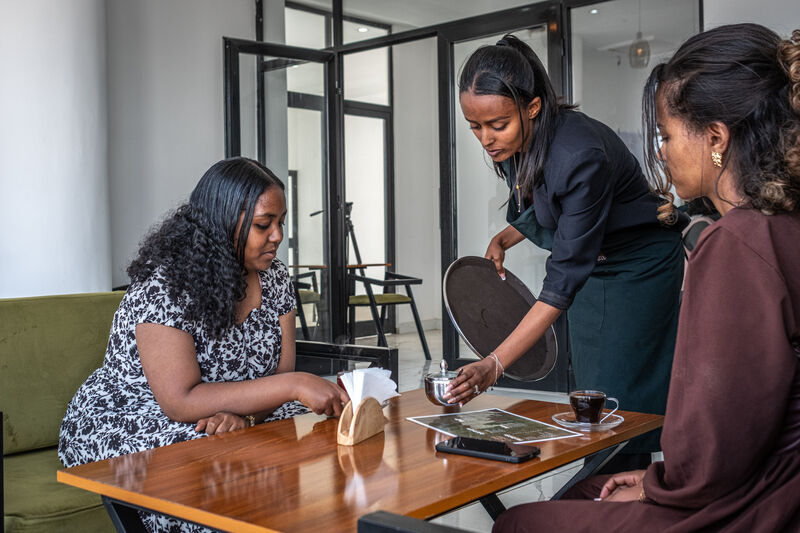
In Shola Gebeya, also in Addis Ababa, 25-year-old Tsion Sertse runs Kalon Coffee. She describes how her mindset shifted when she got her loan. “The experience completely changed my way of thinking: [I went] from employee to entrepreneur,” she says. For Tsion, the Kefeta Youth SACCO’s strength lies in the flexible conditions it offers. “Most organisations ask for guarantees,” she says, while Kefeta does not. In a system of often prohibitive interest rates, being able to access more sustainable conditions makes all the difference. But like her peers, Tsion notes that when “there are liquidity problems”, loans become less accessible and waiting times lengthen.
The lesson from Ethiopia is clear: although the cuts reduced scale and speed, they did not erase what was built to last. In an unstable context, resilience is measured in the ability to keep businesses like these alive – continuing, in the process, to generate opportunities, paid employment, and autonomy. Young people like Beta, Tsion and Tsion embody this entrepreneurial spirit that will ensure a fairer future for Ethiopia.