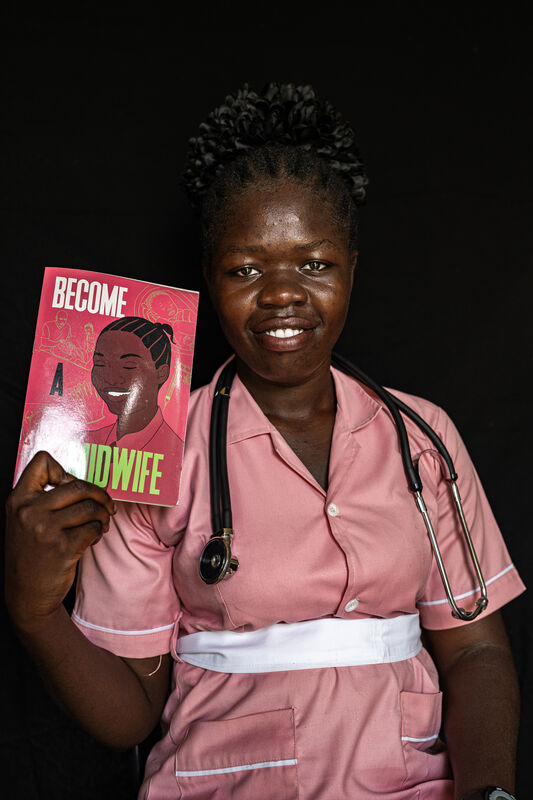
At Maridi Health Sciences Institute in southern South Sudan, trainee midwives like Lawrencia – driven by a passion to serve their communities – are gaining the skills to save lives.
South Sudan is one of the most dangerous places in the world to give birth.
In 2011, the newly independent state had the world’s highest maternal mortality rate – and was home to fewer than 10 trained midwives.
The country has made huge strides since then: from 2011 to 2020, the percentage of mothers who delivered babies in a health facility increased from 16.2% to 41.8%. During the same period, the percentage of mothers who delivered in the presence of skilled health personnel increased from 22.1% to 39.8%. Today, South Sudan has 3,000 qualified midwives.
But progress has not kept pace with trends across the region. Maternal and child mortality rates in South Sudan remain persistently high. Women and babies across the country are dying from largely preventable causes. In many cases, women do not receive adequate care during pregnancy, meaning that complications go undetected until it is too late.
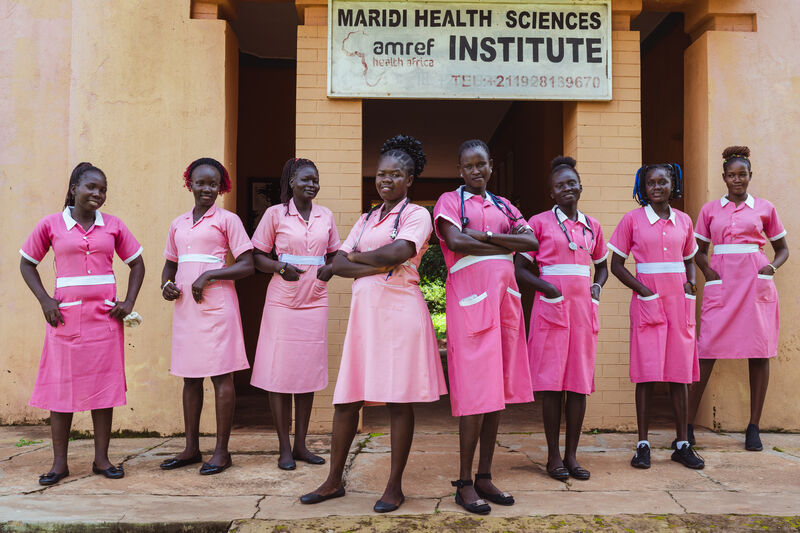
Maridi Health Sciences Institute, in Western Equatoria State – near the border with the Democratic Republic of the Congo – was established pre-independence, in 1998, to increase the number of health workers serving the country’s population. The midwifery programme has been running since 2008, with Amref Health Africa’s constant support. Lawrencia Emmanuel is part of the programme’s most recent intake: the first that has been eligible for scholarships from Amref International University (AMIU).
Lawrencia grew up in Mundri, also in Western Equatoria, where she witnessed pregnant women dying because they could not access the support they needed. The nearest midwife was at the local hospital, five miles away from Lawrencia’s village. The costs associated with the journey meant that care was out of reach for many women in her community. “For a pregnant mother to go a long distance [to give birth] it’s really challenging,” says Lawrencia. “Especially […] because there is no car and alsomotorcycle is not there.”
Lawrencia remembers one woman who could not afford transport to the hospital. When her labour pains started, her neighbours did everything they could to help: “They [carried] the mother using a bicycle. They tied a chair behind the bicycle, and then they put the mother on the chair. They [pushed] her up to the hospital,” remembers Lawrencia. But they weren’t able to move fast enough, and the woman gave birth on the side of the road. Sadly, her baby passed away. The woman herself lost a lot of blood, but her life was saved when she finally made it to the hospital. This story is one of many that drove Lawrencia to pursue her dream of becoming a midwife.
Lawrencia grew up as one of seven children. The loss of her father in 2009 was not only devastating for her and her siblings; it also meant that the family struggled to afford school fees. Despite the pressure, Lawrencia and three of her siblings completed their high school education. When it came to deciding what to do next, Lawrencia was clear: she would be a midwife; her community needed her. But she couldn’t afford the training. When she heard about AMIU’s scholarship programme, she applied and waited nervously for news.
When she learned that her application had been successful, she was convinced she was dreaming. “I said, ‘Ah, someone should wake me up. Is it true that I’m coming to study?’. My husband told me, ‘That’s really true: you have got the scholarship’, and it was my happiest day.”
Lawrencia’s scholarship means that, in addition to attending in-person classes and lab sessions in Maridi, she can join online lectures delivered at AMIU. She can’t wait to start putting her new skills into practice. “When I become a midwife, I will make sure I can stop mothers and their babies from dying, and to keep them safe and healthy,” she says. “I will make sure that every mother gets the proper care, and also, they will have their children alive.
She thinks of maternal and child deaths in terms of the loss they represent not just to families and communities, but to South Sudan. “Those who are dying, suppose maybe they will be having a future?”, she wonders. “Maybe they will be having great work to do […] But when losing their life just like that, it will be a great loss to the country.”
Lawrencia’s ambition goes beyond her own career: she is determined to share her skills. “If they train me, as one person […] if I go back, I will train more,” she says. “Because in a hospital someone cannot work alone: you work together […] So if they train me, I will also train my people.”
“It’s good to have very many midwives, because it can help a lot. It can reduce the rate of deaths from mothers and also the babies. They will all be alive.”
A regular gift of 135CHF per month could cover one year of tuition fees for a trainee midwife at Maridi Health Sciences Institute, who will then go on to support pregnant women and mothers in remote regions where health services are limited and hard to access
Note: Amref Health Africa has had a constant presence in South Sudan for more than 50 years. Our work there began long before it achieved independence from Sudan in 2011, following a referendum held in 2009. 2026 will see the country mark 15 years of independence amidst conflict and an acute hunger crisis, both of which are putting huge pressure on an already-fragile health system.